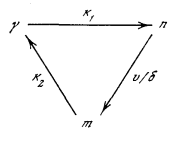
Summary: A mechano-chemical approach to the choice of characteristic variables for the description of the cross-bridge states in active muscle is proposed. A small number of mechanically significant states of the cross-bridge should be postulated to obtain an informative model of the cross- bridge contractile cycle. There exist two simplest models which are capable to describe a variety of experimental data on muscle contraction. In the «kinetic» model /V. I. DESCHEREVSKIĬ, Biorheology 7, 147 (1971)/ two mechanically significant states of the cross-link are postulated in which it develops constant positive («pulling» state) and negative («hindering» state) forces independent of the velocity of contraction.далее…
Abstract—Contractile properties of striated muscle are derived from its structural organization
under some assumptions about myosin crossbridges cyclic action.
Well-known dynamic properties of striated muscle are given quantitatively by the suggested
theory. Hill’s equations follow from the theory automatically and precisely. Calculated rates of force development and redevelopment after quick release coincide with experimental data. The theory accounts for auto-oscillations of insect flight muscles.далее…

The widely accepted steric model of calcium regulation of actin-myosin interactions in vertebrate muscles has to be completed to fit the kinetic data. It should be supposed that: (1) the thin filaments consist of functionally independent units, containing seven actin sites regulated by one troponintropomyosin complex; (2) actin sites become available for myosin heads only due to fluctuations of tropomyosin position; (3) binding of calcium to troponin results either in the shift of the tropomyosin equilibrium position or in the weakening of its interactions with actin strand so that the probability of effective fluctuations increases; (4) link formation between myosin head and some of the available actin site fixates the tropomyosin in such a position that the other six actin sites of the same functional unit become available for myosin too.далее…

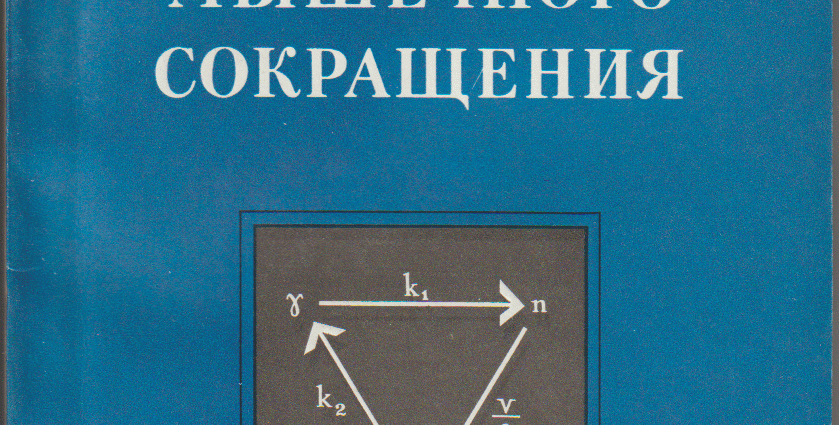
В. И. Дещеревский МАТЕМАТИЧЕСКИЕ МОДЕЛИ МЫШЕЧНОГО СОКРАЩЕНИЯ Под редакцией академика Г.М.ФРАНКА Издательство «НАУКА», Москва, 1977 Книга известного советского биофизика В. И. Дещеревского посвящена одному из весьма плодотворных методов исследования механизма мышечного сокращения — математическому моделированию. Автором предложена кинетическая теория мышечного сокращения, позволившая количественно описать различные режимы сокращения поперечно-полосатых мышц сдалее…